The Vesper Brief

a weather report,with a voice.

Most weather apps fill templates. Vesper writes. Each morning, a short editorial forecast — two sentences with a point of view about your day.

How a brief is written

the editorial method.

A Vesper brief looks effortless on your screen because the work that produces it is invisible. It is not invisible because it is not there. It is invisible because the whole discipline of editorial writing is to make the craft disappear into the sentence. Here is what actually happens between the raw forecast and the words you read.

  1. Read the forecast

    The same JSON blob every weather app receives — pressure, dew point, cloud cover, wind, UV, sunrise, sunset. Twelve or more signals to choose from, each equally available and equally unexciting in raw form.

  2. Identify the dominant story

    One or two signals usually explain what the day is going to feel like. A marine layer lifting. A pressure gradient tightening. A dew point climbing above the comfort threshold. The writer picks the signal that matters and puts it at the center.

  3. Make the editorial cut

    Every other signal is dropped. A brief that lists every available field has failed. A brief that picks one fact and lets it carry the paragraph has earned the reader’s nine seconds.

  4. Write it short, specific, and in voice

    Thirty to sixty words. Present or near-future tense. Specific enough that the sentence could not have been written for any other city on any other day. Restrained enough that no adjective is wasted.

The method is the same every morning in every city. What changes is the dominant story — the specific atmospheric signal that happens to be the one worth writing about today. The rest is cut. The reader gets thirty to sixty words that describe what the day is actually going to feel like, not a grid of numbers nobody reads.

What it sounds like

three cities, three mornings.

A high-pressure ridge slid in overnight. Thin cirrus by mid-afternoon, the kind that makes the light go gold instead of gray. No coat needed, but wear the one you like.
Vesper · San Francisco · Tuesday
Low cloud deck burning off by eleven. The kind of day that starts dull and turns generous. By three the light on the East River will be doing something worth walking to.
Vesper · New York · Thursday
Marine layer holding through noon, steady drizzle that never quite commits. Breaks possible by late afternoon. This is a good day for a window seat and a long coffee.
Vesper · Seattle · Saturday

Voice across seasons

four seasons, four voices, same discipline.

The same editorial method applied to different seasons and different cities produces briefs that share a voice but never a sentence. Boston in January is not Portland in April. A brief that respects the reader respects the difference.

Thirty-one degrees and honest about it. The light has that January New England quality where the sky reads like cut paper and the shadows move slowly. Dress for the wind, not the number.
BostonJanuary
Shoulder-season Portland. Fifty-six with sun, fifty-two with rain, and the day will be both within the same walk. Bring the jacket that folds into a pocket. The Cascades might be visible around three.
PortlandApril
The heat is the plot today. Afternoon thunderstorms by five, then steam coming off the pavement until midnight. Drink water and walk on the shaded side of the street.
New OrleansAugust
Seventy-one at noon, forty-four at sunset, and the dry air will take the warmth with it the second the sun drops. Layers are not optional. The light after five is worth the cold.
Santa FeOctober

Template vs. editorial

what other apps send you.

Template forecast

“Partly cloudy. High of 68°F. Winds W at 5-10 mph. Chance of rain 10%.”

Every weather app on the market uses some version of this. The data is the same. The words are interchangeable.

Vesper Brief

“The marine layer gives up by ten. What follows is the kind of October afternoon that makes people move here. Take lunch outside.”

Same data, different intent. The brief tells you what the day feels like, not just what it measures.

Editorial discipline

what a brief is deliberately not.

Knowing what to leave out is most of the editorial craft. A Vesper brief is a specific thing written against a set of negative constraints — every morning the writer is deciding not to produce several other kinds of weather content. Those other kinds have their place. They are just not this place.

A brief is not a joke

A joke lands once and then gets in the way. An editorial brief is written to be read every morning of every season, which means it cannot depend on novelty for its value. Carrot does jokes well. We are doing something the reader returns to for decades, not a gag that stales in a week.

A brief is not an alert

An alert is a command. Briefs do not command — they describe. If there is severe weather, the operating system handles the push. The brief is for normal days and unusual days alike, in a voice that stays consistent across both. No interruptions, no urgency theater.

A brief is not a data dump

The whole point is to remove the data the reader did not need. A brief that lists six metrics has failed. A brief that leaves out five metrics to land the one that actually shapes the day has succeeded. The cut is the craft.

A brief is not a diary

The writer is not the subject. The reader is. The brief is written about the day from the reader’s perspective, not about the writer’s feelings or the writer’s life. The voice has opinions but the opinions serve the reader’s decision, not the writer’s ego.

Why editorial matters

weather is personal.

68° in San Francisco means fog and a jacket. 68° in Austin means finally opening the windows. A number doesn’t know the difference. A voice does.

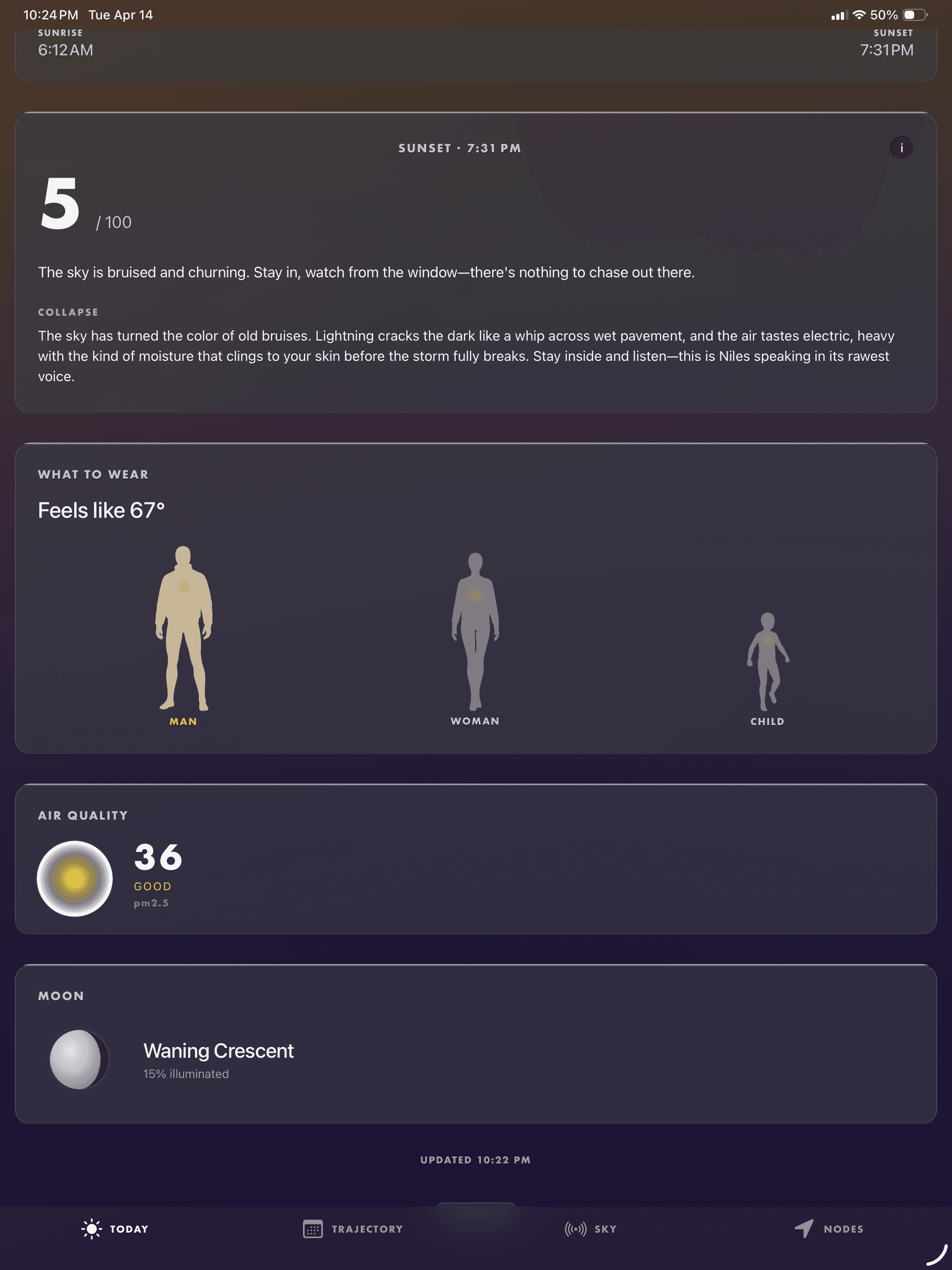
Vesper briefs are opinionated, local, and short. They tell you what the day feels like — not just what it measures. That’s not decoration. That’s the whole point.

The forecast is a raw material. The writing is the product. The editorial pass that happens between the data and the sentence is the entire reason Vesper exists as a category separate from every other weather app on your phone.
When it earns its keep

the days a brief matters most.

Shoulder-season mornings

The hardest days to read from a grid of numbers are the ones where the temperature and the conditions look fine but the sensory experience is strange — humid October, dry December, windy April. These are the mornings a written brief earns its keep.

Golden hour decisions

If you are trying to decide whether to leave the office at six to catch a sunset walk, a temperature grid is no help. A brief that tells you the light is going to do something or is going to stay flat is the whole reason to check the app.

Outfit pivots

The classic weather-app failure is the morning when the number on the app does not match the air outside because the dew point, the wind, or the cloud base changed the sensation. A brief flags that gap, so the layer you grab on the way out the door is the right one.

Editorial briefs by city

read a brief for your city.

Each of these is a short editorial voice sample demonstrating how Vesper writes about the weather in a specific city. Pick one and see how the same editorial method adapts to the personality of the place.

What is a Vesper Brief?

A Vesper Brief is a short editorial weather forecast written in an authorial voice that replaces the template-driven text found in most weather apps. Each brief is a two-to-three sentence narrative covering the day ahead, written with personality and local awareness rather than generated from fill-in-the-blank weather templates.

Frequently Asked Questions

How long is a Vesper Brief?

Each Vesper Brief is two to three sentences, written to be read in under ten seconds while still conveying the essential forecast and a point of view about the day.

Who writes the Vesper Briefs?

Vesper Briefs are generated by an AI editorial system trained on weather writing style, then reviewed for accuracy against forecast data from trusted meteorological sources.

How is a Vesper Brief different from Apple Weather?

Apple Weather uses template-driven text that fills in variables like temperature and conditions. Vesper writes each forecast as original prose with personality and local context.

Can I get a Vesper Brief for my city?

Yes. Vesper generates briefs for any location worldwide using data from multiple meteorological sources. Set your location and receive a fresh brief every morning.

Are Vesper Briefs accurate?

Vesper Briefs are based on the same NWS and ECMWF data that powers major weather apps. The editorial layer adds voice and interpretation, not speculation.

Can I customize the tone of the brief?

No. The brief is written to a consistent editorial voice so it reads the same every morning across every city. Customization would break the voice. Carrot Weather lets you pick a personality. Vesper is one voice, applied consistently.

Does the brief work on Apple Watch?

Yes. The Vesper Brief headline is available as a watchOS complication and in the dedicated Apple Watch app, so you can read it from your wrist without opening your phone.

What data sources are Vesper Briefs based on?

Briefs are generated from live atmospheric data via Apple WeatherKit and other trusted meteorological sources including NWS and ECMWF model runs. The editorial layer processes temperature, dew point, cloud cover, wind, pressure, and humidity into a two-to-three sentence forecast with voice.

Is there a library of past Vesper Briefs?

Yes. Every brief you receive is archived in your personal journal inside the app, so you can scroll back through months of editorial forecasts for your city and see how the voice adapts across seasons.

K